Choosing between drive-in vs radio shuttle racking for food and beverage warehouses usually comes down to three operational pressures: FIFO pallet storage for cold storage, high-density pallet racking for perishable goods, and temperature-controlled warehouse organization. Managers must also balance cold chain logistics, pallet flow, and SKU velocity against LIFO/FIFO rules, load capacity, and FEFO compliance. A beverage warehouse may need maximum density for one product, while a dairy distributor may need selective access to many short-life batches. The wrong warehouse racking system can increase forklift travel, product damage, loading errors, and temperature exposure.
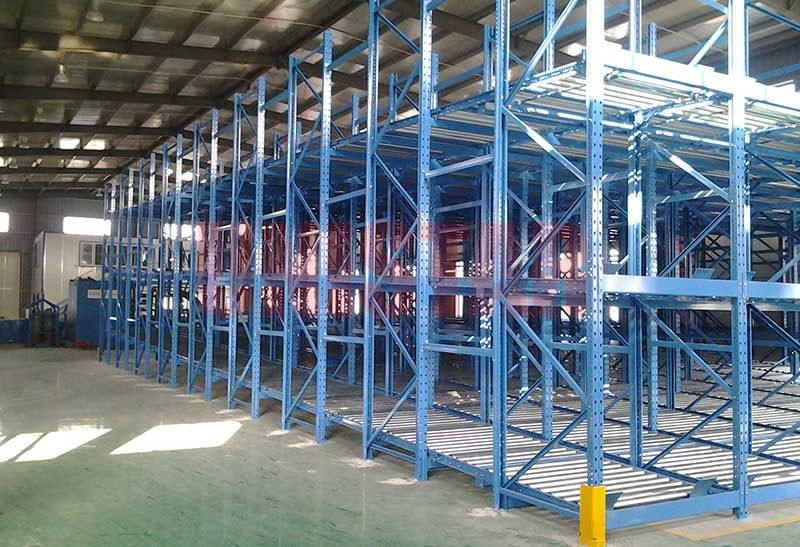
At first glance, both systems appear to solve the same problem: storing more pallets in less floor space. The operational difference becomes clear during receiving and dispatch. Drive-in racking requires a forklift to enter the storage lane and handle pallets on support rails. Radio shuttle racking uses a battery-powered shuttle to move pallets inside the lane, while the forklift remains at the lane entrance.
This distinction matters in cold rooms, where every additional forklift movement can increase door-open time and expose products to temperature fluctuation. It also matters when a warehouse handles mixed expiration dates, damaged pallets, strict sanitation procedures, or frequent replenishment.
For a single-SKU beverage reserve area, drive-in can offer a lower initial investment and high storage density. For frozen food, dairy, meat, or packaged food with multiple batches, radio shuttle usually provides better control over pallet movement and safer separation between forklifts and rack structures.
Drive-in racking creates deep storage lanes supported by rails. The forklift enters the lane, places the pallet on the rail, and reverses out. In most installations, each lane is dedicated to one SKU or product family because the last pallet loaded is normally the first pallet retrieved.
This makes drive-in a natural fit for LIFO pallet storage. It is less suitable where the warehouse must pick the oldest production batch first or apply FEFO, meaning “first expired, first out.” Some operators use drive-through configurations to support FIFO, but this requires access from both ends and typically reduces the density advantage compared with one-sided drive-in storage.
High-volume, low-SKU storage: A soft-drink distributor storing 20-pallet blocks of the same bottle or can can use each lane for one flavor, package size, or production batch.
Reserve inventory: Drive-in is effective for products held in bulk rather than picked daily.
Lower capital budgets: The system has no shuttle vehicle, charging station, or control interface.
Cold-storage density: A properly designed layout can use approximately 60% to 85% of the available floor area for pallet storage, depending on aisle width, fire-code requirements, room geometry, and lane depth.
The main risk is forklift exposure inside the rack. Operators must align accurately with the rails and avoid striking uprights, pallet stops, and rear bracing. A damaged frame can require immediate lane isolation, product removal, and structural inspection.
Drive-in also creates a product-rotation problem. If a lane contains several production dates, the newest pallet may block the older one. This can increase expiration risk, particularly for chilled products with a 14- to 45-day shelf life.
Forklift travel time is another consideration. In a 10-pallet-deep lane, the driver may enter and exit repeatedly for each loading or retrieval cycle. If the average internal travel distance is 18 meters per pallet and the warehouse handles 500 pallet movements per day, the additional travel can exceed 9 kilometers daily before accounting for turning, waiting, and positioning.
A radio shuttle system places a motorized shuttle carriage on the rack rails. The forklift deposits a pallet at the lane entrance, and the shuttle transports it to the next available position. During retrieval, the shuttle brings the selected pallet back to the front.
Operators control the shuttle through a handheld remote or warehouse control interface. Functions commonly include pallet loading, pallet retrieval, lane inventory, automatic positioning, obstacle detection, and low-battery warnings. The forklift does not need to drive deep into the rack, which can reduce rack-impact exposure and shorten the time spent with cold-room doors open.
Medium- to high-SKU inventories: Each lane can be assigned to a product, batch, temperature category, or expiration group.
FEFO and FIFO workflows: The system supports controlled loading and retrieval sequences when lane rules and warehouse software are correctly configured.
Deep-lane cold storage: Lanes of 20 to 40 pallets can be practical where product volume justifies the equipment investment.
Reduced forklift entry: Keeping the forklift at the face of the rack can reduce collision opportunities and improve operator visibility.
Labor consistency: Shuttle travel is repeatable and does not depend on a driver moving to the correct depth at every cycle.
Radio shuttle is not an automatic replacement for warehouse management discipline. The system still requires correct pallet dimensions, stable loads, battery management, rack inspections, and defined lane rules. A shuttle cannot compensate for inaccurate inventory records or mixed products placed in the same lane.
The initial cost is higher, and maintenance planning is essential. A cold-storage operator should specify battery performance at the actual operating temperature, charging procedures, spare shuttle availability, and emergency pallet-retrieval methods. Equipment rated for ambient warehouses may not deliver the same battery runtime in a freezer operating around -18°C.
| Parameter | Drive-In Racking | Radio Shuttle Racking | Operational Meaning |
|---|---|---|---|
| Typical storage method | Forklift enters deep lane | Shuttle moves pallet inside lane | Radio shuttle reduces deep-lane forklift travel |
| Best inventory logic | LIFO; FIFO possible with drive-through layout | FIFO, FEFO, or LIFO with programmed procedures | Radio shuttle is generally more adaptable to batch rotation |
| Practical lane depth | Commonly 4–10 pallets deep | Commonly 10–40 pallets deep | Actual depth depends on pallet weight, fire code, and product handling |
| Storage density | Approximately 60%–85% floor utilization in suitable layouts | Approximately 65%–90% floor utilization in suitable layouts | Both outperform selective pallet racking for bulk storage |
| Forklift access | Forklift enters the rack lane | Forklift normally works from the rack face | Radio shuttle can reduce rack-impact exposure |
| SKU suitability | Low SKU count and large pallet blocks | Medium or high SKU count with lane separation | Mixed SKU lanes remain poor practice in either system |
| Temperature-control benefit | Limited; depends on forklift and door procedures | Potentially stronger because forklift entry is reduced | Useful in freezer and chilled warehouses |
| Capital cost | Lower | Higher due to shuttle equipment and controls | Compare total cost per stored pallet, not only rack price |
| Maintenance | Structural inspections and rail maintenance | Rack, rail, shuttle, battery, sensor, and control maintenance | Radio shuttle requires a more detailed service plan |
| Product access | Limited selectivity within a lane | Improved control but still lane-based, not fully selective | Selective pallet racking remains better for one-pallet-per-SKU picking |
Frozen warehouses commonly face low temperatures, high labor costs, and pressure to maximize cubic capacity. Radio shuttle is often the stronger choice when pallets are heavy, lanes are deep, and the facility follows batch or expiration controls. Keeping forklifts near the rack face can reduce unnecessary travel inside the freezer.
Drive-in can still be appropriate for frozen products that move in large, uniform blocks. For example, a frozen vegetable distributor with six core SKUs and stable monthly demand may gain more financial value from a simple drive-in installation than from adding shuttle equipment.
Dairy products often require FEFO rather than simple FIFO. Yogurt, fresh milk, and cultured products may have narrow dispatch windows, so lane assignment must reflect production date and expiration date.
Radio shuttle is generally better when the warehouse handles several batches per SKU or dispatches partial lanes throughout the day. Drive-in is workable when each lane contains a single batch and replenishment follows a strict schedule.
Beverage warehouses often have high pallet weights but predictable product families. Drive-in can be cost-effective for reserve stock, particularly when one lane holds a full production run of the same can, bottle, or case configuration.
Radio shuttle becomes more attractive when the facility handles promotional packaging, seasonal flavors, returnable containers, or frequent batch changes. The system can also reduce forklift congestion at the rack face when inbound and outbound activity overlap.
Flour, sugar, cans, cartons, and packaging materials may not require FEFO in every case, but they often have different pallet dimensions and replenishment frequencies. Drive-in works well for standardized pallets stored in large blocks. Radio shuttle is preferable when the warehouse must separate allergen-related materials, production lines, or quality-hold inventory.
Budgetary pricing varies by country, steel grade, seismic requirements, installation labor, refrigeration conditions, pallet weight, and automation scope. The following ranges are useful for early planning rather than final procurement.
| Cost Item | Drive-In Estimate | Radio Shuttle Estimate |
|---|---|---|
| Rack structure and rails | Approximately US$80–US$180 per pallet position | Approximately US$120–US$260 per pallet position |
| Shuttle vehicle | Not required | Approximately US$15,000–US$35,000 per unit |
| Controls and charging | Usually not required | Approximately US$5,000–US$25,000 depending on scope |
| Installation complexity | Lower | Moderate to high |
| Five-year cost drivers | Forklift impact, rail damage, labor, product access | Battery replacement, shuttle service, controls, labor, rack inspections |
For a 1,000-pallet-position project, a drive-in system may have a lower upfront equipment cost by tens of thousands of dollars. However, the calculation changes if radio shuttle reduces the number of forklifts, shortens freezer travel, improves pallet retrieval accuracy, or prevents product write-offs caused by expiry.
A practical return-on-investment model should include five measurements: pallet positions gained, pallet movements per day, average forklift travel distance, labor hours per movement, and monthly product loss from damage or expiry. For example, saving 2.5 labor hours per shift at a loaded cost of US$28 per hour over 300 operating days produces approximately US$21,000 in annual labor savings before considering energy and maintenance.
In one documented warehouse project review, an anonymized beverage distributor operating approximately 1,200 pallet positions compared drive-in and radio shuttle for reserve inventory. The site handled a limited number of high-volume SKUs, with most lanes holding between 12 and 18 pallets. Its main concern was not order picking; it was forklift congestion during inbound replenishment.
The drive-in proposal had the lower purchase price and met the required static load capacity. The radio shuttle proposal cost more, but it kept forklifts at the lane entrance. After implementation, the operator reported that average reserve-pallet retrieval time fell from roughly 4.5 minutes to 2.8 minutes during the busiest shift. The warehouse also reported fewer rack-contact incidents in the first six months. These figures were operational observations rather than an independently audited time study, but they influenced the final decision.
The manager’s practical conclusion was that drive-in remained suitable for slow-moving reserve stock, while radio shuttle performed better in lanes replenished and emptied several times per week. The final layout used high-density drive-in for stable bulk SKUs and radio shuttle for faster-moving promotional beverages.
A second anonymized case involved a chilled dairy distributor managing multiple production dates for yogurt and fresh desserts. The original drive-in layout created a recurring problem: newer pallets were placed in front of older pallets because the lanes were not fully emptied before replenishment. Staff then spent additional time searching for the correct batch, and some short-life products required markdowns or disposal.
The revised radio shuttle design assigned lanes by product family and date group. Warehouse staff scanned pallet labels at receiving, placed pallets at the lane face, and used the shuttle retrieval sequence for dispatch. The operator reported a reduction in average batch-search time from approximately 6 minutes to less than 3 minutes per retrieval and a reduction in weekly expiry-related write-offs over the following operating period.
Radio shuttle did not solve the problem alone. The improvement also depended on barcode discipline, FEFO rules, regular inventory reconciliation, and supervisor checks. This is an important lesson: a warehouse racking system supports process control, but it cannot replace accurate data or trained operators.
Warehouse teams that favor drive-in usually mention its simplicity, lower purchase cost, and suitability for full-pallet blocks. Operators often appreciate that there are fewer electronic components to troubleshoot. The most common criticism is restricted access to inner pallets and the need for careful forklift driving.
Users who favor radio shuttle commonly mention smoother deep-lane handling, reduced forklift entry, and better separation of batches. Their main complaints are higher capital cost, battery charging responsibility, and the need for technical support when a shuttle or control component fails.
| User Priority | Frequently Reported Preference | Reason |
|---|---|---|
| Lowest initial investment | Drive-in | Fewer mechanical and electronic components |
| Reduced forklift entry | Radio shuttle | Shuttle transports pallets inside the lane |
| Stable, high-volume SKUs | Drive-in | Simple lane dedication works effectively |
| Batch rotation and FEFO | Radio shuttle | Better control of loading and retrieval sequences |
| Ease of maintenance | Drive-in | No shuttle battery or control system |
| Cold-room labor efficiency | Radio shuttle | Less forklift travel inside deep lanes |
At least 70% of the stored volume consists of stable, high-volume SKUs.
Most lanes can be dedicated to one product, batch, or package format.
LIFO storage is acceptable, or a true drive-through FIFO layout is financially justified.
The warehouse has experienced forklift operators and a strong rack-impact inspection program.
The primary objective is to increase storage density while controlling capital expenditure.
The facility operates in chilled or frozen conditions where forklift travel and door-open time matter.
Products require FIFO or FEFO, and several batches are active at the same time.
Deep lanes are needed, but forklift entry would increase safety or product-damage risk.
Daily pallet movement is high enough to justify shuttle utilization.
The business can support battery charging, preventive maintenance, operator training, and spare-part planning.
| Rank | Warehouse Type | Recommended System | Reason |
|---|---|---|---|
| 1 | High-volume frozen reserve warehouse | Radio shuttle | Deep lanes, lower forklift entry, and better control in cold conditions |
| 2 | Single-SKU beverage bulk warehouse | Drive-in | High density with predictable LIFO movement and lower initial cost |
| 3 | Chilled dairy FEFO warehouse | Radio shuttle | More suitable for batch separation and expiration-date control |
| 4 | Food ingredient reserve warehouse | Drive-in or hybrid | Choice depends on allergen separation, SKU count, and replenishment frequency |
| 5 | Mixed-case food picking warehouse | Selective or flow-rack combination | Neither deep-lane system is ideal for frequent individual-pallet access |
UNISTAR can be considered when the project requires a customized warehouse racking system rather than a standard rack dimension. The useful evaluation points are not brand claims alone; they include steel thickness, upright profile, beam or rail load rating, pallet tolerance, surface treatment, cold-room compatibility, installation control, and after-sales service. A buyer should request layout drawings, load calculations, shuttle specifications, inspection procedures, and a total-cost comparison before selecting a supplier.
Pallet data: Confirm length, width, height, gross weight, bottom-board design, and pallet condition.
Inventory data: Review SKU count, pallets per SKU, daily receipts, daily dispatches, batch frequency, and expiration rules.
Temperature data: Specify operating temperature, condensation risk, defrost cycles, and battery performance requirements.
Building data: Check clear height, floor flatness, slab load, column positions, sprinkler requirements, and seismic conditions.
Equipment data: Confirm forklift type, lift height, aisle width, shuttle capacity, charging time, and spare-unit strategy.
Food-safety data: Require cleanable finishes, corrosion-resistant treatment where appropriate, protected rack ends, and a documented hygiene inspection process.
Process data: Define whether the operating method is LIFO, FIFO, or FEFO and connect the rule to barcode or warehouse-management procedures.
Drive-in racking is suitable for food and beverage warehouses with predictable, high-volume pallet blocks, a limited SKU range, and strong pressure to reduce upfront cost. It is not the best choice for highly mixed inventories, frequent batch changes, strict FEFO requirements, or operations where forklift impact is a persistent problem.
Radio shuttle racking is suitable for cold-chain facilities, deep-lane storage, higher pallet throughput, and products requiring controlled FIFO or FEFO rotation. It is less suitable for very small warehouses, low-volume storage, or businesses without the maintenance capability to support battery-powered equipment.
The most balanced solution may be a hybrid warehouse racking system: drive-in for slow-moving bulk inventory and radio shuttle for fast-moving, short-life, or temperature-sensitive products. Before requesting a quotation for drive-in vs radio shuttle racking for food and beverage warehouses, FIFO pallet storage for cold storage, or high-density pallet racking for perishable goods, calculate cold chain logistics cost, pallet flow, and SKU velocity together with FEFO compliance, load capacity, and LIFO/FIFO rules. Then ask UNISTAR or another qualified supplier for two dimensioned layouts, a five-year total-cost model, and a site-specific safety review before making the final decision.
Next step: Prepare your pallet dimensions, storage temperature, SKU count, daily pallet movements, and required FIFO or FEFO procedure. Use those figures to compare a drive-in layout, a radio shuttle layout, and—where appropriate—a hybrid design on cost per usable pallet position rather than rack price alone.